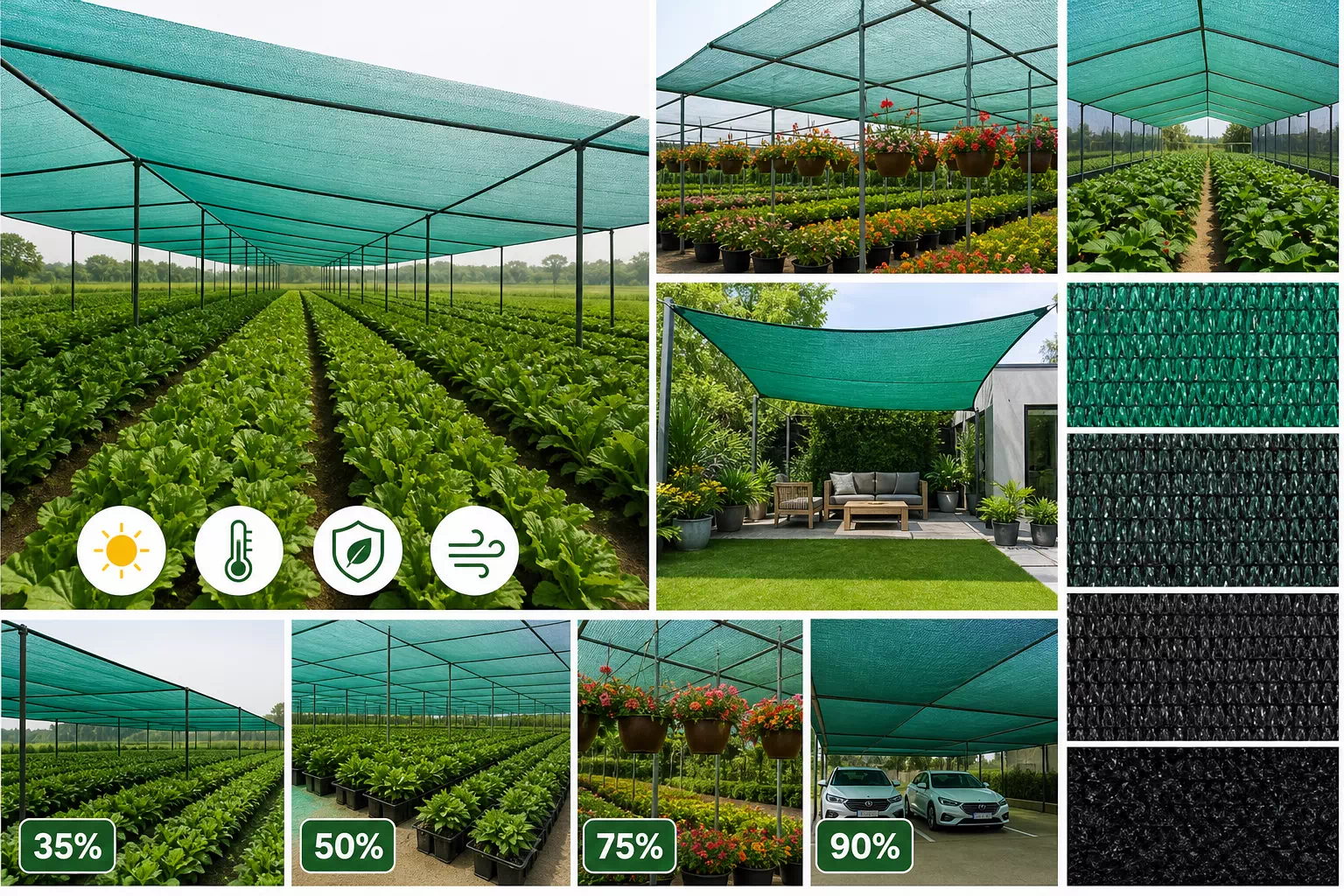
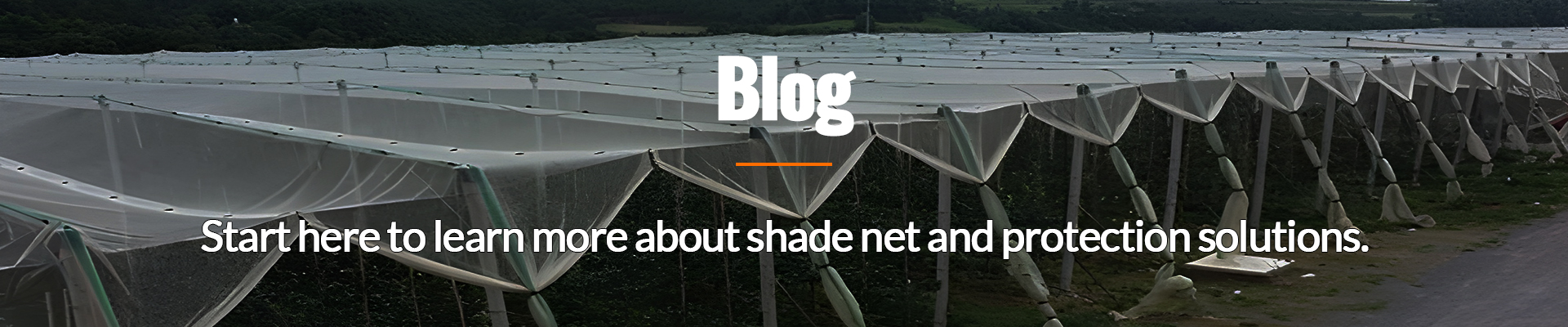
“Shade net” can refer to several different products. A greenhouse grower may need to reduce strong sunlight. A nursery may need adjustable shade for young plants. An orchard may need protection from birds or hail instead.
These products should not be selected by color or name alone. Shade net manages sunlight. Insect netting creates a physical barrier. Hail and bird nets protect against specific outside risks. Greenhouse covers provide a more continuous covering system.
Short answer: Identify the main problem first, then confirm the appropriate net type, shade percentage or mesh opening, material, width, edge treatment and installation method.
Main Types of Shade Net and Agricultural Netting
| Product type | Main purpose | Common applications | Key specification |
| Shade net | Reduce direct sunlight and solar load | Greenhouses, nurseries, gardens and farms | Shade percentage, material, color and width |
| Greenhouse shade net | Manage light and heat around protected crops | Vegetable, flower and nursery production | Shade level, installation position and fixing |
| Insect-proof net | Create a barrier against selected insects | Greenhouse vents, sides and nurseries | Mesh opening, airflow and dimensions |
| Hail protection net | Reduce the impact of hail | Orchards, vineyards and open-field crops | Strength, opening, support and weather exposure |
| Bird protection net | Reduce bird access to crops | Orchards, gardens, vineyards and fruit farms | Mesh opening, durability and edge closure |
| Greenhouse cover | Provide a continuous covering environment | Greenhouses, tunnels and seasonal production | Film type, thickness, light transmission and size |
| Windbreak or privacy net | Reduce wind or visual exposure | Farms, nurseries, gardens and outdoor areas | Density, height, strength and fixing |
One project may use more than one type. For example, a greenhouse may have a greenhouse cover as its main enclosure, shade net for summer light control and insect netting at the ventilation openings.
1. Shade Net for Light and Heat Management
Shade net is used when direct sunlight is stronger than the crop or growing area can comfortably manage. It can be installed over a greenhouse, above a nursery, beside a growing area or over a garden structure.
Common applications include:
•Greenhouse vegetable production.
•Seedling and nursery areas.
•Flowers and ornamental plants.
•Open-field crops during hot periods.
•Garden and patio shade structures.
•Temporary or seasonal shade projects.
The shade percentage is an important specification, but it is not the only one. Also consider the crop, season, climate, ventilation, installation position, material, color, width and edge finishing.
A higher shade percentage is not automatically better. It may reduce more direct sunlight, but it can also reduce useful light during cloudy weather or in low-light regions. For more guidance, read  How to Choose the Right Shade Cloth Percentage for Your Greenhouse.
2. Flat-Wire and Round-Wire Shade Net
Shade net may be produced in flat-wire or round-wire structures. The two types can differ in appearance, handling, weight, available width and production range.
When comparing them, confirm:
•Material and construction.
•Shade percentage.
•Grammage or weight.
•Available width and length.
•UV treatment.
•Edge finishing.
•Suitability for fixed or removable installation.
Do not assume that two products with the same color have the same structure or performance. Request a sample when the product will be used in a commercial greenhouse or sold through a distribution channel.
3. Greenhouse Shade Net
Greenhouse shade net is installed inside, outside or on selected sides of a greenhouse to manage the light environment.
External installation
External shade net is placed above the greenhouse covering. It may intercept direct sunlight before it reaches the film or glass. This arrangement can be considered in hot and sunny climates.
The main points to check are wind exposure, edge fastening, tension, frame strength and maintenance access.
Internal installation
Internal shade net may be easier to adjust or remove in some structures. However, the available space, vents, fans, irrigation equipment and crop height must be reviewed before installation.
Internal shade net does not replace ventilation. Hot air still needs a route out of the greenhouse.
Seasonal installation
For seasonal production, a removable, retractable or divided system may be more practical than fixed coverage. The buyer should explain how the net will be rolled, folded, stored or reinstalled so the manufacturer can recommend suitable edges and fixing points.
4. Insect-Proof Netting
Insect-proof netting creates a physical barrier at greenhouse vents, side walls, doors, nurseries and crop structures. Its main selection factor is usually the mesh opening rather than shade percentage.
A finer mesh may help exclude smaller insects, but it can also restrict airflow more than an open mesh. The right balance depends on the target pest, climate, humidity and ventilation system.
Before ordering, confirm:
•Mesh opening or mesh size.
•Material.
•Width and length.
•Edge treatment.
•Installation position.
•How doors, seams and corners will be sealed.
A small gap at an edge or opening can reduce the effectiveness of the whole barrier. Insect netting should also be checked against the greenhouse ventilation plan.
5. Hail Protection Net
Hail protection net is used to reduce the impact of hail on crops, fruit and plant structures. It is commonly considered for orchards, vineyards, berry crops and open-field production.
Its effectiveness depends on the net, support structure, installation tension, local wind and the severity of the weather event. It should not be selected by shade percentage alone.
Confirm the following before ordering:
•Coverage area and span.
•Support structure.
•Opening and material.
•Edge treatment.
•Expected wind and weather exposure.
•Access for inspection and harvesting.
A product that works over a small garden cannot automatically be scaled to a commercial orchard without reviewing the structure and installation load.
6. Bird Protection Net
Bird protection net is designed to reduce bird access to crops, fruit, ponds, gardens or other protected areas. The opening size and installation method should match the type of bird and the area being protected.
Common applications include:
•Fruit orchards.
•Vineyards and berry fields.
•Vegetable gardens.
•Nurseries.
•Fish ponds and selected agricultural facilities.
Large spans require suitable support and careful edge closure. The buyer should also consider how the net will be opened for harvesting and maintenance.
Bird netting should not be treated as insect-proof netting. The opening required to reduce bird access is usually different from the opening required to exclude small insects.
7. Greenhouse Cover and Shade Net: Different Roles
Greenhouse covers and shade nets are often used together, but they perform different jobs.
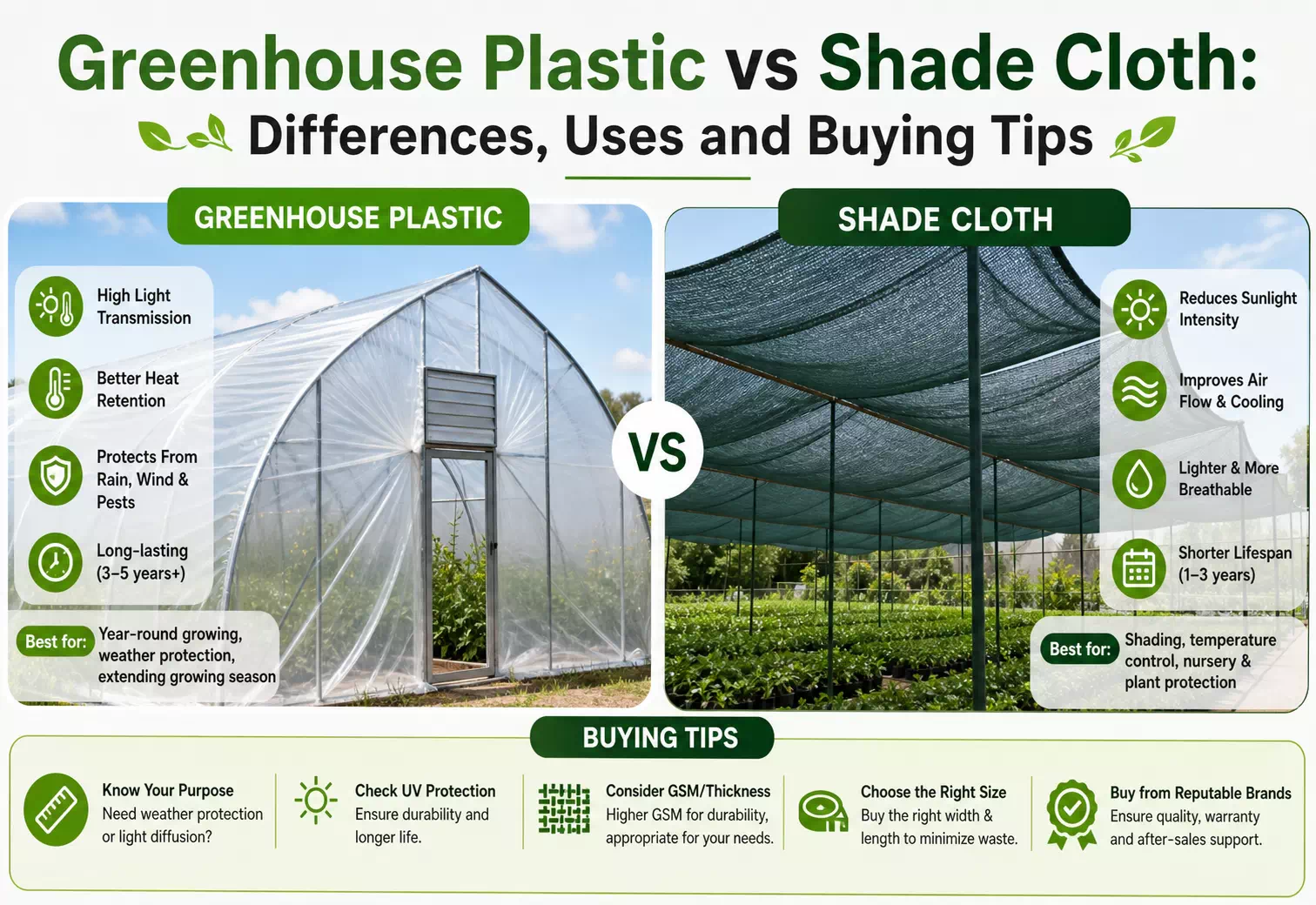
A greenhouse cover provides a more continuous barrier for rain, enclosure and seasonal production. Shade net manages direct solar radiation and may be added when the greenhouse becomes too bright or hot.
Project requirement | Product to consider |
Continuous rain protection | Greenhouse cover |
Strong direct sunlight | Shade net |
Insect control at vents | Insect-proof netting |
Hail risk in an orchard | Hail protection net |
Bird access to fruit | Bird protection net |
Seasonal light adjustment | Removable or retractable shade net |
A shade net should not be treated as a replacement for a rainproof greenhouse cover. A greenhouse cover alone may also be insufficient if the structure has poor ventilation or excessive solar load.
For a detailed comparison, read Greenhouse Plastic vs Shade Cloth: Differences, Uses and Buying Tips.
Product Types by Application
Greenhouses
Greenhouses may need a combination of cover, shade net and insect netting. The best combination depends on the crop, climate, season and ventilation design.
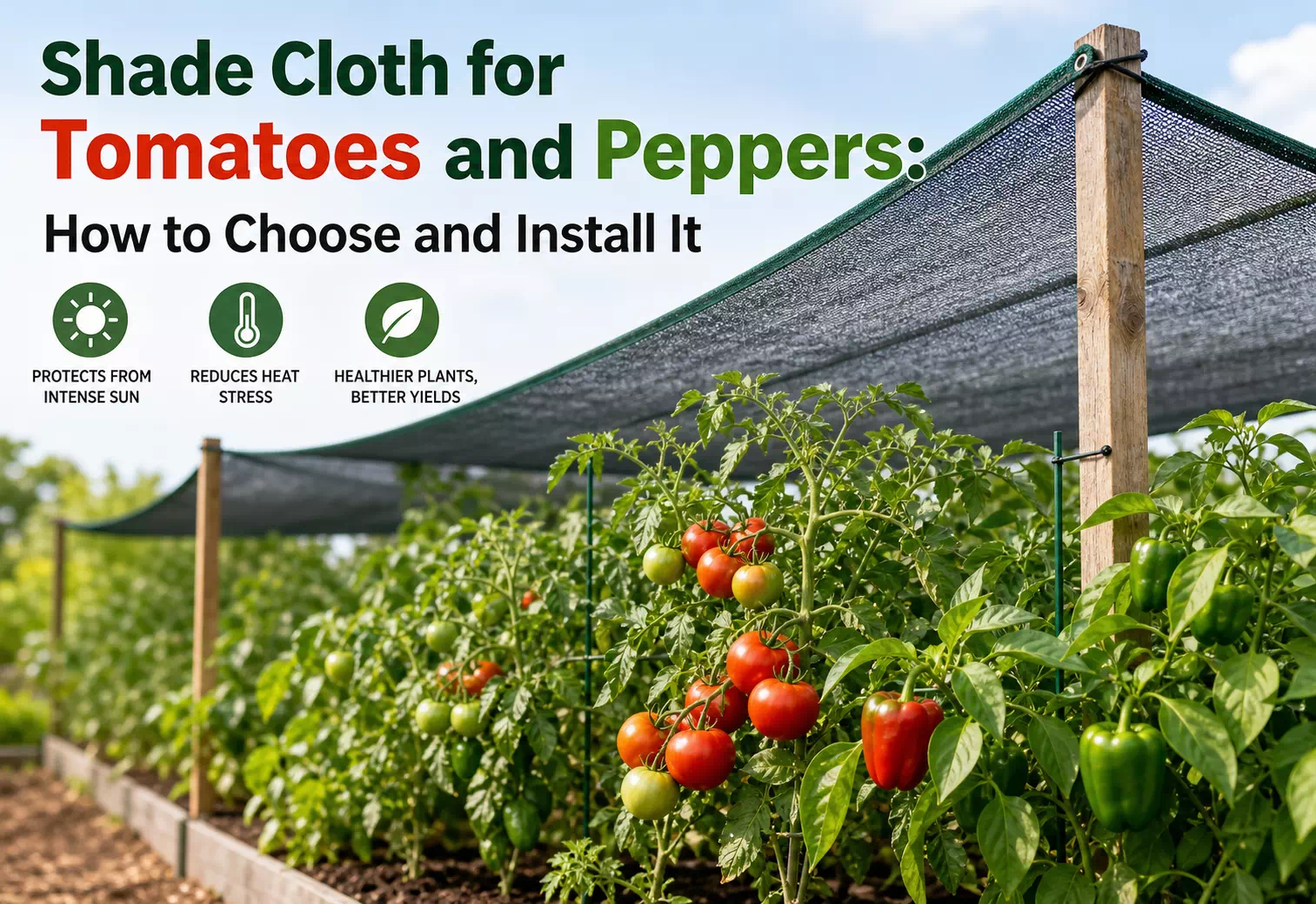
Tomatoes and peppers may need additional shade during intense heat, but the final decision should also consider crop stage, irrigation and airflow. See Shade Cloth for Tomatoes and Peppers for crop-specific considerations.
Nurseries and seedling houses
Nurseries often need flexible light control and protection from insects or severe weather. Removable shade net and insect-proof netting may be used in different areas.
Ease of handling is important. Confirm the finished width, edge treatment and storage method before ordering.
Orchards and vineyards
Orchards and vineyards may require bird or hail protection rather than general shade. The support structure, span, harvesting access and local wind should be reviewed before selecting a net.
Open-field crops
Open-field projects may use shade net during hot periods, insect netting for crop protection or hail netting where weather damage is a concern. The product should match the crop, season and installation method.
Gardens and landscape areas
Garden projects may prioritize shade, appearance, privacy and easy installation. Color options such as black, green, beige and white can be considered according to the design.
Even for a small area, confirm the coverage dimensions, fixing points, wind exposure and whether the net will be removed seasonally.
Color and Installation Choices
Shade net may be available in black, green, white, beige, striped or other colors. Color can affect the appearance of the project, but it does not define the shade percentage or material.
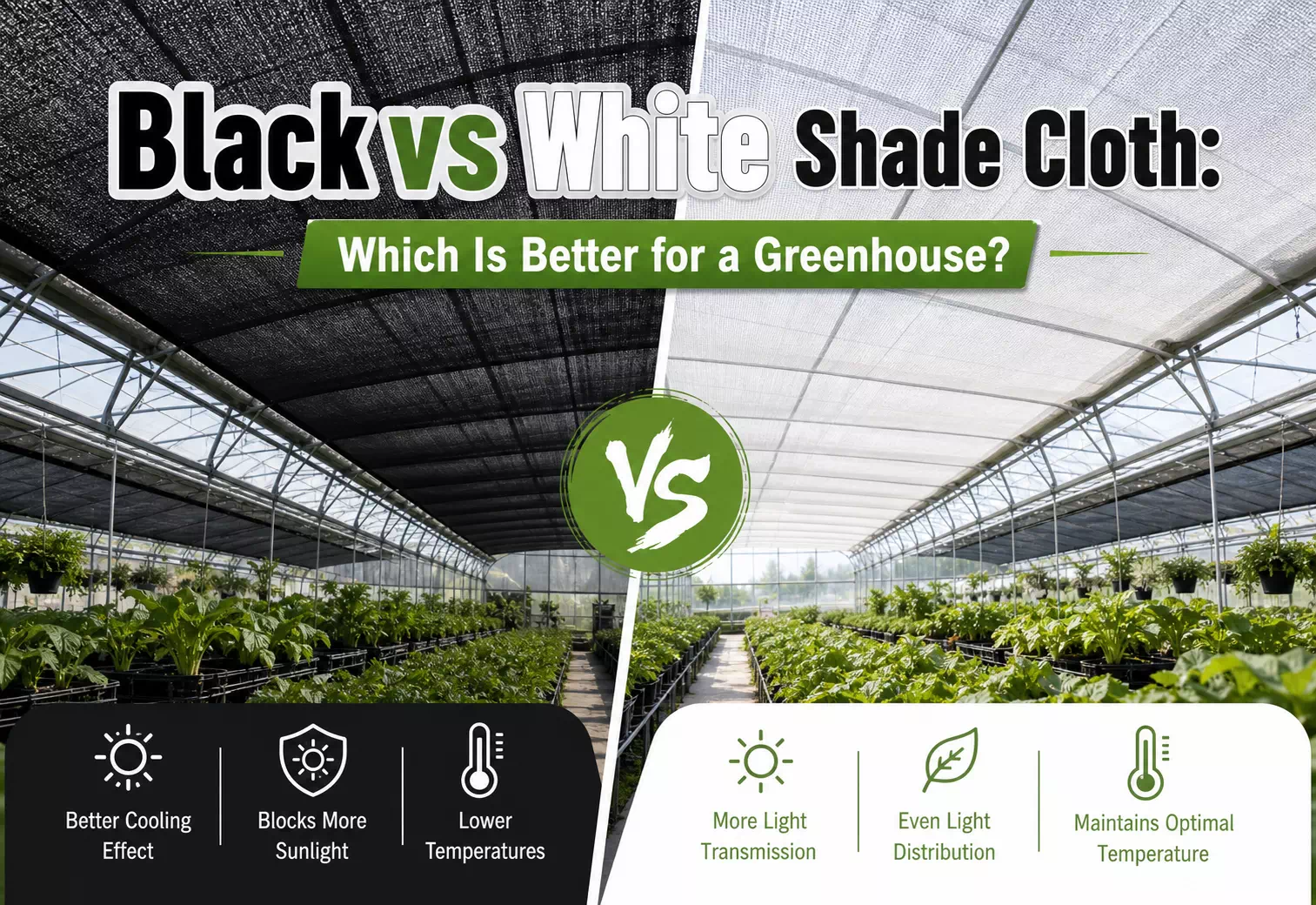
A black net is not automatically a high-shade net, and a white net is not automatically suitable for every greenhouse. Compare products using similar shade percentage, material, construction and weight. See Black vs White Shade Cloth for a direct comparison.
Installation also affects performance:
•Fixed systems need reliable edges and support points.
•Removable systems need suitable folding, labeling and storage.
•Retractable systems need compatible tension and operating space.
•Roof installations usually face more direct sun and wind.
•Side installations may be used for shade, privacy, wind reduction or insect protection.
What to Confirm Before Ordering
Send the manufacturer the following information:
Project detail | Example |
Main purpose | Shade, insect, hail, bird, wind or rain protection |
Crop or area | Tomatoes, seedlings, orchard, vineyard, garden or nursery |
Installation | Roof, side, vent, open field, fixed or removable |
Dimensions | Required width, length and coverage area |
Main specification | Shade percentage, mesh opening or material requirement |
Edge treatment | Standard, reinforced, taped, eyelets or other finish |
Quantity | Area, roll count or package count |
Destination | Country or port and target delivery date |
If you are not sure which product you need, describe the problem instead of naming the product too early. For example, “We need to protect a fruit orchard from birds and keep harvesting access” gives the supplier more useful information than “Please quote agricultural net.”
Frequently Asked Questions
What are the main types of agricultural netting?
Common types include shade net, insect-proof netting, hail protection net, bird protection net, greenhouse cover and windbreak or privacy net. Each type has a different main purpose.
Is shade net the same as insect-proof netting?
No. Shade net mainly reduces direct sunlight. Insect-proof netting creates a physical barrier and is selected by mesh opening, airflow and installation sealing.
Can one net protect crops from sun, insects and birds?
Some products may provide more than one function, but this should not be assumed. Confirm the shade level, mesh opening, material and installation requirements for each risk.
What shade percentage should I choose?
The starting point depends on the crop, climate, season, greenhouse position, light level and airflow. A higher percentage is not automatically better.
What information should I send a manufacturer?
Send the application, crop or protected area, location, product purpose, installation position, dimensions, material, shade or mesh requirement, edge treatment, quantity and destination.
Final Product Selection Checklist
Before ordering, confirm:
1.What problem does the net need to solve?
2.Is the required product a shade, insect, hail, bird or greenhouse net?
3.What crop or area will it protect?
4.Where will it be installed?
5.Is the key specification shade percentage, mesh opening or another requirement?
6.What material, color, width and length are available?
7.Will the net be fixed, removable or retractable?
8.How will the edges be fixed and maintained?
9.Can the manufacturer provide a sample and written specification?
Request an Agricultural Netting Recommendation
The right agricultural netting starts with the application, not the color or product name. Shade net, insect netting, hail net, bird net and greenhouse cover each serve different purposes.
Tell Dawei what you need to protect, where the net will be installed, the required coverage area, local climate and estimated quantity. Our team can help you review the suitable shade net or agricultural netting type for your project.
Visit Dawei Shade Net to discuss greenhouse shade nets, agricultural protection netting and custom requirements. Confirm the final specifications, packaging and delivery terms before ordering.