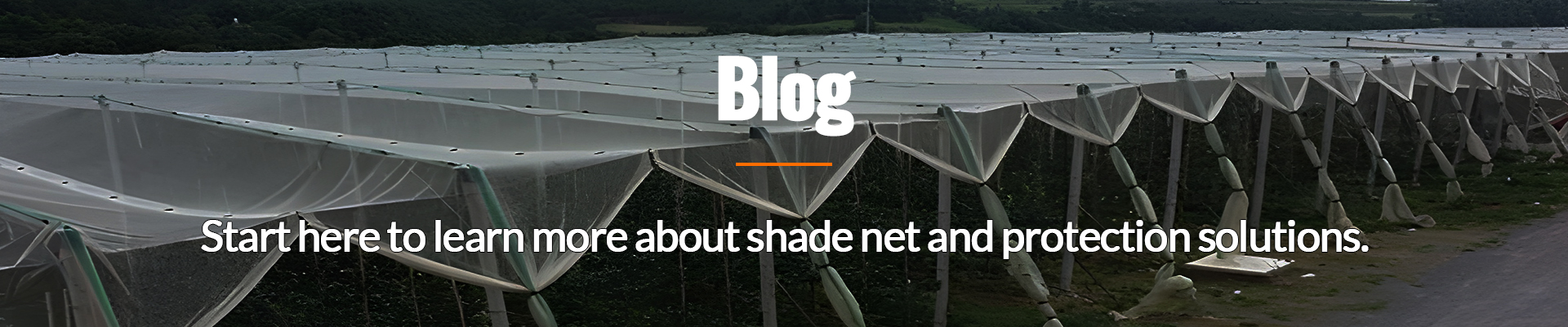
Every year, small pests like thrips, whiteflies, and aphids cause billions of dollars in crop damage worldwide — and the damage isn't just from feeding. Many of these insects transmit plant viruses that can destroy an entire greenhouse crop in days. The most effective, chemical-free defense is a physical barrier: insect netting.
But here's the problem most growers face: insect netting comes in dozens of mesh sizes, and choosing wrong is expensive. Too fine a mesh and you suffocate your crop with heat and humidity. Too coarse and pests walk right in. So how do you choose?
This guide breaks down the three most common sizes — 25 mesh, 40 mesh, and 50 mesh — by the pests they block, the crops they protect, and the climates where they work best. By the end, you'll be able to select the right insect net in under five minutes.
1. What Does "Mesh Size" Actually Mean?
Before comparing sizes, let's define the term — because it's the source of most confusion in the market.
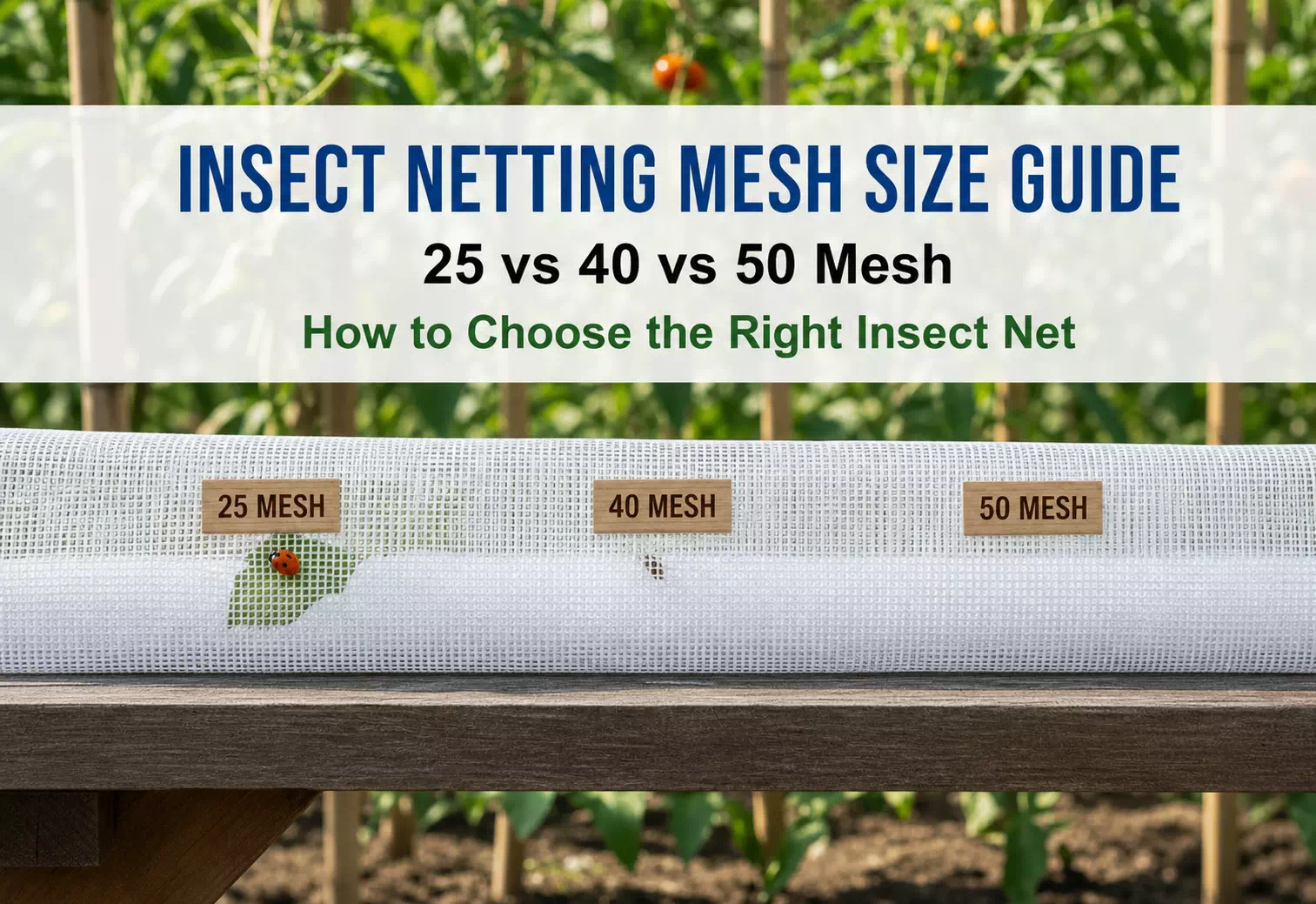
Mesh size refers to the number of threads per inch (or per 2.54 cm) in the netting. A 25-mesh net has 25 openings per inch; a 50-mesh net has 50 openings per inch. Higher mesh number = smaller holes = finer protection.
Mesh Size | Approx. Hole Size | What It Means Visually |
17 mesh | 1.42 × 1.42 mm | Coarse, like window screen on steroids |
25 mesh | 0.77 × 0.77 mm | Medium, good balance for most farms |
40 mesh | 0.40 × 0.77 mm | Fine, rectangular openings |
50 mesh | 0.27 × 0.77 mm | Very fine, nearly fabric-like |
75+ mesh | 0.15 × 0.45 mm | Ultra-fine, research-grade |
Manufacturer Note: Hole sizes vary between manufacturers even at the same mesh count, because yarn thickness and weave structure differ. Always ask for the actual opening size in millimeters — not just the mesh number — when comparing suppliers. A "40 mesh" from one factory may have 0.45 mm openings while another has 0.30 mm.
2. The Big Question: 25 vs 40 vs 50 Mesh — Which Do You Need?
The answer depends on three factors, in order of importance:
Which pests are your biggest threat? (body size determines mesh)
What crop are you protecting? (value and virus sensitivity)
What's your climate? (ventilation trade-off)
2.1 Match the Mesh to the Pest: Body Size Table
Insects enter through openings larger than their thorax width (the widest body segment). Here's the critical reference table:
Pest | Thorax / Body Width | Minimum Mesh Required | 25 Mesh | 40 Mesh | 50 Mesh |
Moths, butterflies (large) | >1.5 mm | 17 mesh | ✅ | ✅ | ✅ |
Fruit flies (Medfly, melon fly) | 1.0 – 1.4 mm | 25 mesh | ✅ | ✅ | ✅ |
Spotted wing drosophila (SWD) | 1.0 – 1.4 mm | 25 mesh (40 for berries) | ⚠️ | ✅ | ✅ |
Flea beetles | 0.6 – 0.8 mm | 25 mesh | ✅ | ✅ | ✅ |
Leafminers | ~0.6 mm | 25-40 mesh | ✅ | ✅ | ✅ |
Aphids | >0.34 mm | 40 mesh | ⚠️ | ✅ | ✅ |
Whiteflies | 0.24 – 0.29 mm | 40-50 mesh | ❌ | ✅ | ✅ |
Thrips | 0.15 – 0.25 mm | 50+ mesh | ❌ | ⚠️ | ✅ |
Mites | <0.2 mm | 75+ mesh | ❌ | ❌ | ⚠️ |
Reading this table:
25 mesh blocks everything from large moths down to leafminers. It's your "workhorse" mesh for field vegetables with moderate pest pressure.
40 mesh adds reliable protection against aphids and whiteflies — the two biggest virus vectors. It's the standard for greenhouse vegetables.
50 mesh is the only choice when thrips are the problem, especially on high-value crops where thrips-vectored viruses (like TSWV) cause total loss.
2.2 The Viral Disease Factor: Why Finer Isn't Just About Pests
Here's what many buying guides miss: the mesh choice is often dictated by viruses, not just insect feeding damage.
Whiteflies transmit Tomato Yellow Leaf Curl Virus (TYLCV) and ToCV; thrips transmit Tomato Spotted Wilt Virus (TSWV). One infected whitefly can introduce a virus that spreads through your entire crop within weeks. If your region has high virus pressure, the equation changes — you need 40 or 50 mesh even if the feeding damage alone wouldn't justify it.
Research-backed rule of thumb: For crops at risk of whitefly-vectored viruses (tomatoes, peppers, eggplant, melons), 40 mesh is the practical minimum. For thrips-vectored viruses, 50 mesh or finer is recommended.
2.3 The SWD (Spotted Wing Drosophila) Special Case
Berries have their own nemesis: the spotted wing drosophila, which lays eggs inside ripening fruit. Unlike other fruit flies, SWD crawls and probes rather than just flying, so the net must be physically strong, not just fine.
For blueberries, raspberries, strawberries, and blackberries: 40 mesh is the industry standard. Research confirms any mesh with openings under 1.0 mm (25 mesh and above) prevents SWD entry, but berry growers overwhelmingly choose 40 mesh for the extra reliability margin.
3. Crop-by-Crop Mesh Recommendations
Now let's combine pest pressure, crop value, and virus sensitivity into practical recommendations:
Crop | Recommended Mesh | Why |
Leafy greens (lettuce, spinach, kale) | 25 mesh | High airflow priority; aphids manageable with IPM; avoids heat damage |
Cabbage & brassicas | 25-32 mesh | Blocks caterpillars and moths; airflow critical in hot climates |
Tomatoes (field) | 25 mesh | Good balance; virus pressure moderate |
Tomatoes (greenhouse) | 40 mesh | Whitefly/virus protection is essential |
Peppers & eggplant (greenhouse) | 40 mesh | Same whitefly/virus logic as tomatoes |
Cucumbers, melons | 25-40 mesh | Depends on whitefly pressure in your region |
Strawberries, blueberries, raspberries | 40 mesh | SWD exclusion is non-negotiable |
Seedlings & nurseries | 40-50 mesh | Young plants are most vulnerable to early pest attack |
Flowers & ornamentals | 40-50 mesh | Appearance quality demands precise exclusion |
Grapes / orchards | 17-25 mesh | Primarily bird + large insect protection; see our bird netting guide |
Golden rule: When in doubt between two sizes, choose the finer one only if your ventilation system can handle it. The crop must be able to breathe.
4. Climate & Ventilation: The Trade-Off Nobody Tells You About
Here's the fundamental tension in insect netting: finer mesh blocks more pests but also blocks more airflow. Every mesh size reduces ventilation — and reduced airflow means higher temperature and humidity inside, which can cause:
Heat stress on crops (growth slows above 30°C for most vegetables)
Condensation and fungal diseases (botrytis, powdery mildew)
Reduced transpiration → calcium deficiency in tomatoes and peppers
Quantified Airflow Impact
Mesh Size | Open Area (porosity) | Relative Airflow | Heat Build-Up Risk |
25 mesh | 45 – 55% | Excellent | Low |
40 mesh | 30 – 35% | Moderate | Medium |
50 mesh | 25 – 28% | Reduced | High |
75 mesh | 18 – 22% | Very low | High (needs mechanical ventilation) |
Climate-Based Recommendations
Climate | Best Choice | Reasoning |
Hot & tropical | 25 mesh | Ventilation is critical; fine mesh raises temps to dangerous levels |
Warm & temperate greenhouse | 40 mesh | Whitefly + aphid exclusion worth the airflow cost |
Cool temperate / highlands | 40-50 mesh | Lower cooling needs, so finer protection is affordable |
Hot climate + high virus pressure | 40 mesh + side vents | Compromise: fine enough for whiteflies, ventilated enough to avoid heat stress |
Pro Tip from Our Factory: If you're in a hot, humid climate and need 50 mesh protection, consider installing it only on the windward side and vents, keeping larger mesh on the leeward side. This "hybrid mesh" approach balances protection and airflow — and it's a configuration we regularly produce for clients in Southeast Asia and the Middle East.
5. Beyond Mesh Size: 3 More Factors That Decide Netting Performance
5.1 Material: Why HDPE Dominates
Nearly all commercial insect nets are made from High-Density Polyethylene (HDPE) — for good reason:
UV stabilization: Quality HDPE nets last 5–8 years outdoors; cheap non-UV nets degrade into brittle dust within one season
Tensile strength: Monofilament HDPE resists tearing from wind and handling
Chemical resistance: Withstands horticultural sprays and disinfectants
Cost: Far more economical than nylon or polyester for the same performance
5.2 Knitted vs Woven: What Actually Matters
Feature | Woven HDPE | Knitted HDPE |
Mesh precision | Stable, uniform openings | Slightly variable |
Cut resistance | Won't unravel when cut | May run along a cut line |
Flexibility | Stiffer, holds shape on frames | Stretchy, drapes over irregular shapes |
Best for | Fixed frames, greenhouse vents, tunnels | Draping over crop hoops, small gardens |
5.3 Color: More Than Aesthetics
Research on colored insect nets shows real biological effects:
Net Color | Effect on Pests | Best Use |
White / crystal | Neutral, maximizes light transmission | Leafy greens, low-light regions |
Yellow / blue | Lower thrips, whitefly, and aphid populations | High-value crops with mixed pest pressure |
Black | Highest shading effect | Warm climates needing shade + insect control |
Grey | Reduced mite populations | Crops with mite problems |
6. How to Install Insect Netting for Maximum Effectiveness
Even the perfect mesh fails if installed poorly. Follow these rules:
Install before pests appear — not after. Prevention beats removal, always.
Tension the net tightly — sagging creates gaps at the edges where insects enter.
Seal every entry point — doors, vents, and overlaps must be fully closed; this is where most pest breakthroughs happen.
Keep it off the leaves — use hoops or frames to maintain 20–30 cm clearance for airflow.
Inspect seams weekly — a single 2 cm tear can negate the entire barrier.
For greenhouses: place netting on outside of vents when possible — it blocks insects before they reach the opening.
7. Common Mistakes to Avoid
Mistake | Consequence | Fix |
Choosing mesh by "feel" instead of pest size | Pests pass through, crop loss | Match to the smallest target pest's thorax width |
Buying non-UV-stabilized net to save money | Net degrades in 1 season | Verify UV rating (look for 700 kly / 5-year spec) |
Ignoring ventilation needs in hot climates | Heat stress, fungal disease | Use 25 mesh or add mechanical ventilation |
Installing too late | Pests already established inside | Set up before pest season begins |
Leaving entry points unsealed | Pests bypass the net entirely | Inspect doors, vents, and overlaps weekly |
Comparing suppliers by mesh number only | Hidden hole size differences | Ask for actual opening size in mm |
8. The 5-Step Selection Checklist
Use this before every purchase:
Identify your #1 pest problem — check leaf undersides and yellow sticky traps; find the smallest pest species present
Look up its body width in the table in Section 2.1
Check your virus risk — if whiteflies or thrips vector diseases in your region, go one size finer
Assess your climate — can your greenhouse/frame provide enough airflow with a fine mesh?
Verify supplier specs — ask for actual opening size (mm), weight (g/m²), yarn diameter, and UV rating
9. FAQ
Q: Is 25 mesh or 40 mesh better for vegetable gardens?
A: For most open-field vegetable gardens, 25 mesh is the sweet spot — it blocks fruit flies, beetles, caterpillars, and leafminers while maintaining excellent airflow. Choose 40 mesh if you have persistent aphid or whitefly pressure, or if growing in a greenhouse where ventilation is more controlled.
Q: Does 50 mesh insect netting block bees and pollinators?
A: Yes — 50 mesh will block most bees, just like finer nets generally do. For crops that need pollination (tomatoes, cucumbers, melons), either remove the netting during flowering, introduce bumblebees or stingless bees inside the protected area, or use a larger mesh on sections of the structure during the pollination window.
Q: Will insect netting cause overheating?
A: Any net reduces airflow, and finer meshes reduce it more. In hot climates, a 25 mesh adds minimal heat risk; a 50 mesh can raise internal temperatures significantly. Solutions include choosing 25-40 mesh where possible, installing hybrid mesh configurations, and ensuring vents are adequate.
Q: How long does insect netting last?
A: Quality UV-stabilized HDPE insect netting lasts 5–8 years outdoors. The lifespan depends on UV stabilizer content, weave quality, and whether you store it indoors during the off-season. Cheap non-UV nets can fail within one growing season.
Q: Can I use bird netting as insect netting?
A: No — bird netting has openings of 15–25 mm, far too large to block insects. However, you can layer them: bird netting outside for birds and larger animals, insect netting inside for pests. For fruit trees needing both bird and insect protection, this combination is common practice.
Q: What mesh size do I need for thrips?
A: Thrips have a thorax width of roughly 0.15–0.25 mm, so you need 50 mesh or finer (75 mesh for the smallest species like western flower thrips). This comes with significant airflow reduction, so plan ventilation accordingly.
Q: How do I clean and store insect netting?
A: At season's end, remove the net, brush off debris, wash gently with mild soap if needed, dry completely, and store in a cool, dark, dry place. Proper storage can extend net life by several years.
10. Final Verdict: Which Mesh Should You Buy?
Your Situation | Recommended Mesh |
Field vegetables, moderate pests | 25 mesh |
Greenhouse tomatoes/peppers | 40 mesh |
Berries (SWD risk) | 40 mesh |
Thrips problem / high-value ornamentals | 50 mesh |
Hot, humid climate | 25 mesh (or hybrid) |
Virus-heavy region (whiteflies/thrips) | 40-50 mesh |
The one-sentence summary: Start with your smallest pest, check your virus risk, then verify your ventilation can handle the mesh you choose — and always buy from a supplier who publishes actual opening sizes, not just mesh numbers.
Ready to Choose Your Insect Net?
As a manufacturer of UV-stabilized HDPE insect netting (17 to 75 mesh, widths up to 12 meters), we can supply samples, technical specs, and custom mesh configurations for your specific crops and climate. Our engineers can help you design a hybrid mesh system that balances pest protection with ventilation.
Get a Free Quote → Contact our team
Have questions about choosing mesh size for your specific crop? Drop a comment below or reach out — we answer every inquiry with data, not guesses.